

Construction projects today operate within high-risk environments where schedule compression, modular delivery, and operational continuity leave no room for incomplete documentation. Static record drawings fall short in capturing the reality of installed systems. Owners and operators now require verified, data-rich as-built models that represent the true built environment and support informed decisions for expansion, renovation, and long-term maintenance. Without this precision, facilities face costly surprises, clashes during retrofits, and extended downtime during system upgrades.
The shift toward integrated delivery models such as Design-Build, IPD, and BIM-enabled FM. It has elevated the importance of high-fidelity as-builts. These models must reflect actual field conditions, incorporate approved change orders, and embed asset-level data across all systems. These models are no longer created solely for turnover they now drive operational workflows, space planning, preventive maintenance strategies, and performance analysis. Their accuracy directly impacts lifecycle cost, compliance, and the ability to future-proof infrastructure.
For asset-intensive facilities such as airports, healthcare campuses, manufacturing plants, and large commercial complexes, verified as-builts provide the foundational dataset for all future interventions. Whether scaling electrical loads, rerouting HVAC systems, or integrating with CMMS platforms, these models must be structured, validated, and traceable. As-built accuracy is about documentation, asset strategy for scalable operations, expansion resilience, and smart building evolution.
Understanding Modern As-Built Models
Modern as-built models are generated through a tightly controlled scan-to-BIM process, where high-resolution LiDAR scans or photogrammetry datasets are registered, cleaned, and converted into geometry that reflects precise field conditions. These models capture dimensional variances that often go unnoticed in traditional redline workflows such as misaligned embeds, field-modified duct risers, or beam penetrations that deviate from the original coordination model. In high-density zones like above-ceiling MEP corridors or mechanical shafts, even minor inaccuracies can disrupt future expansion or system upgrades. By anchoring model geometry to point cloud data with tolerances often within ±10mm, project teams can establish a verified baseline for all downstream interventions.
The shift toward these verified as-builts has redefined accountability across AEC roles. These models support field clash detection and allow precise planning of tie-ins during phased expansions. For MEP contractors, they document true routing paths, valve access clearances, and system terminations critical to lifecycle servicing. Architects and structural engineers use them to assess actual load paths or wall-core deviations before renovation. These models form the only reliable reference for future facility changes, ensuring that operations, compliance inspections, and capital planning are based on field-validated truth.

Core Functions and Lifecycle Benefits
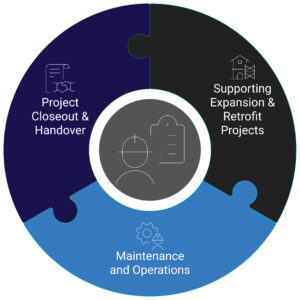
Supporting Expansion and Retrofit Projects
Accurate models allow project teams to map physical constraints with centimeter-level fidelity capturing riser shaft congestion, actual duct elevations, slab edge variances, and embedded mechanical sleeves. This precision becomes critical when integrating new systems into occupied zones or executing phased vertical expansion, where assumptions based on design intent could lead to destructive rework or service interruptions.
Maintenance and Operations
Lifecycle-use models incorporate field-located asset IDs, QR-coded equipment data, and zone-specific system hierarchies that connect directly to CMMS platforms. For facility engineers, this means being able to isolate a shutoff valve within seconds, assess clearance for filter replacement, or verify panel loads during emergency outages—all without relying on outdated PDFs or paper schedules that often contradict site conditions.
Project Closeout and Handover
Instead of fragmented turnover documents, a federated model consolidates all RFI-driven changes, deviation reports, and post-inspection markups into one navigable digital environment. This gives owners operational visibility into what was installed, where, and how it deviated from the original scope. It also reduces future change-order disputes and accelerates integration with enterprise asset management systems, especially in regulated environments like healthcare or infrastructure.
Technology Stack for High-Accuracy As-Built Models
Reality Capture & Field Data Acquisition
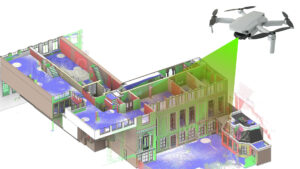
High-fidelity as-builts begin with rigorous site data acquisition using terrestrial LiDAR scanners, mobile mapping units, and drone-based photogrammetry. These tools capture millions of georeferenced points with millimeter accuracy, even in active construction zones or retrofits with obstructed visibility. Field teams often supplement scans with 360° photo capture, structured walkthroughs, and GPS-tagged imagery to ensure full spatial context and metadata traceability. When coordinated across trades, this baseline reduces reliance on manual markups and minimizes blind spots in congested areas.
BIM & Model Structuring
Once point clouds are processed and aligned, the model is structured using discipline-specific LOD standards, embedded parameters, and logical system hierarchies. Above-ceiling zones, riser shafts, and mechanical plant rooms are modeled with priority accuracy due to their density and expansion sensitivity. The BIM environment supports simulation for airflow, capacity, and energy demand enabling predictive planning tied directly to verified geometry. Data-rich objects within the model are configured to support FM integration and long-term traceability.
Connected Construction Tools
Cloud-based platforms like Autodesk Construction Cloud, Trimble Connect, and Dalux act as the central CDE, enabling synchronized updates from field to model in near real-time. Mobile apps support daily scan uploads, RFI tagging, and live clash tracking, while automated version control ensures audit trails for each model iteration. These tools form the backbone for ensuring that as-built models remain current throughout construction and fully coordinated at turnover.
Creating, Managing, and Validating As-Built Models
Preconstruction Planning
Model accuracy begins before construction mobilization, with trade-specific scanning scopes embedded into the BIM Execution Plan and project QA matrix. Coordination zones—like vertical shafts, interstitial floors, and plenum-heavy corridors; are flagged for early-stage scanning and tighter tolerance thresholds. Scanning logistics, registration control points, and field-access protocols are aligned with installation sequencing, ensuring that reality capture is not treated as a disconnected QA step but a parallel verification stream from day one.
Active Construction Phase
As systems are installed, deviations from coordination drawings such as shifted duct drops, rotated VAV boxes, or relocated panelboards. These are captured through localized LiDAR or structured 360° walkthroughs. Field techs use mobile platforms to push point cloud snippets or annotated photos into the CDE, triggering model updates tied to specific system zones. For trades working in congested environments, this allows progressive validation and prevents downstream service conflicts. Model updates are version-controlled and traceable, reflecting every in-field deviation with associated rationale.
Post-Construction & Turnover
Final model QA does not rely on visual checks alone. Deviation maps and point-to-model comparisons are generated for high-risk zones, highlighting any geometry that exceeds project tolerance (e.g., pipe drops misaligned by >25mm or ductwork impinging on fire clearances). All RFIs, change orders, and redline data are consolidated into structured model metadata—not external logs ensuring lifecycle traceability. Turnover deliverables include fully validated geometry with embedded system identifiers, commissioning data, and O&M asset links, supporting operational continuity from day one of occupancy.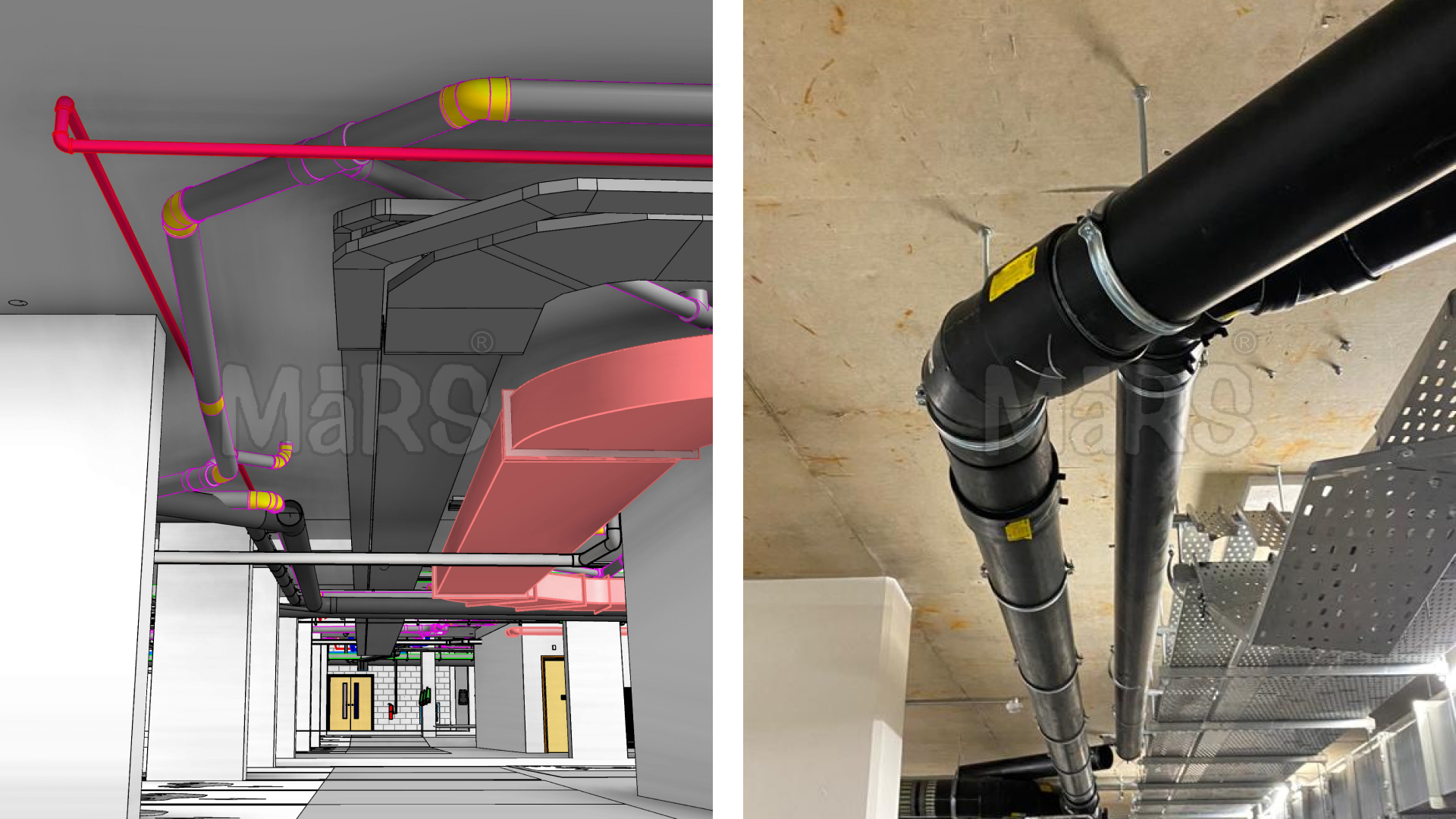
Model-Driven Expansion and Maintenance Planning
As-built models built from verified scan data allow project teams to assess expansion feasibility with spatial and system-specific precision. In mission-critical zones, such as electrical rooms, mechanical shafts, and data center corridors. These models document exact routing offsets, installed system elevations, valve access tolerances, and mechanical clearances. Teams can analyze available riser space, verify spare panel capacity, and confirm pressure zone configurations before proposing branch extensions or equipment swaps. Embedded data such as system redundancy, hydraulic flow limits, and electrical load balancing supports simulation for up-sizing or backfeeding without disrupting live operations. This allows design consultants, MEP engineers, and FM planners to run clash-free retrofits and system transitions digitally eliminating reliance on site assumptions and avoiding shutdowns during high-risk modifications.
Quality Assurance and Governance
Field-governed QA for as-built models includes point-to-model deviation tracking by zone, discipline-specific tolerance enforcement, and embedded RFI lineage for every geometry override. Rather than storing changes in external logs, validate construction shifts like relocated hangers or reoriented conduit banks. These are logged within object metadata and tied to scanned evidence. This approach ensures regulatory traceability, eliminates post-handover disputes, and establishes a verifiable record that meets both operational and audit requirements.
Adoption Best Practices
- Coordinate scan access with critical path activities—avoid scheduling capture during ceiling closure, system insulation, or scaffold removal to preserve visibility for high-density zones.
- Use trade-specific naming conventions in model object data to support post-handover troubleshooting.
- Link RFI response IDs to individual model objects to preserve the decision trail behind field deviations for modified structural penetrations and rerouted MEP branches.
- Apply progressive scan validation in riser and shaft zones where last-minute routing changes often go undocumented; mark these areas as “as-built confirmed” only after backfill or access closure.
- Tag inaccessible or future-service assets with unique IDs and install photos embedded into model properties for reference during future tie-ins.
- Structure model updates in sync with subcontractor sign-off milestones, ensuring trade accountability before federated model lock and turnover packaging.
- Maintain a version-controlled deviation log per system, separate from design intent, that captures geometry overrides tied to scan comparisons and construction-phase constraints.
- Integrate warranty-critical data at the object level, such as install date, commissioning approval, and service clearance, to eliminate post-handover warranty invalidation due to undocumented field changes.
Adopting these practices transforms the as-built model from a compliance deliverable into a high-value operational asset bridging field complexity with long-term facility resilience and lifecycle control.
Conclusion
As-built models, when constructed with verified field geometry, embedded RFI lineage, and service-critical asset data, become more than a turnover artifact—they function as operational control layers for future system tie-ins, phased expansion, and risk-managed maintenance. Their accuracy directly impacts retrofit feasibility, load recalculations, shutdown planning, and warranty compliance. Firms that institutionalize scan-integrated workflows and object-level traceability meet client handover specs, future-proof built environments for adaptive reuse, modular upgrades, and smarter asset decisions long after construction ends.



Recent Comments